
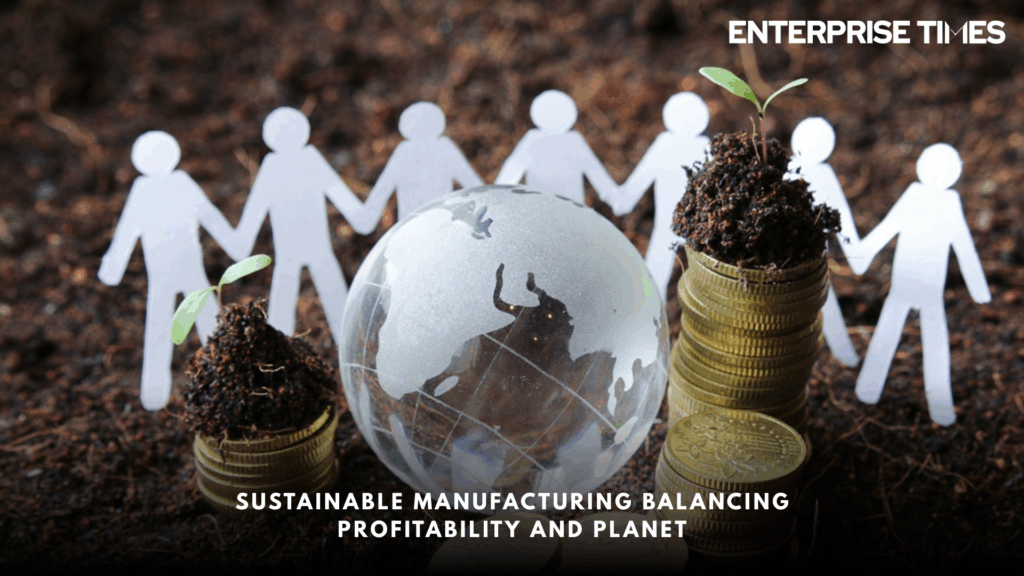
In a world where industrial growth is accelerating at unprecedented rates, the concept of sustainable manufacturing has shifted from being a corporate aspiration to a global necessity. Today’s manufacturers are tasked with a dual responsibility to remain profitable while reducing their environmental footprint. This delicate balancing act between profitability and planet is reshaping how industries operate, innovate, and compete in a resource-constrained world.
The New Manufacturing Paradigm
Manufacturing has long been the backbone of the global economy, driving innovation, employment, and trade. However, it has also been one of the most resource-intensive sectors responsible for nearly one-fifth of global carbon emissions and a significant share of waste and water pollution.
As governments tighten environmental regulations and consumers become more eco-conscious, the traditional “produce more, sell more” model is no longer sustainable. Businesses must now embrace a circular economy mindset, where efficiency, renewable energy, and material reuse are at the core of every process.
According to the World Economic Forum, the shift toward sustainable manufacturing could generate $4.5 trillion in new economic value by 2030 through resource efficiency, innovation, and new business models. The message is clear that sustainability is not just an ethical choice; it is a powerful growth strategy.
Profitability and Sustainability Not Mutually Exclusive
For years, many manufacturers have viewed sustainability as a cost burden. However, data increasingly shows that eco-friendly operations can enhance profitability.
Companies that adopt energy-efficient processes, optimize supply chains, and invest in smart technologies often see measurable cost savings. For example:
- Siemens achieved over 20% energy savings across its production sites by integrating data-driven energy management systems.
- Unilever’s Sustainable Living brands have consistently outperformed the company’s average growth, proving that customers reward responsible production.
- Toyota’s lean manufacturing model, focused on waste reduction and efficiency, remains one of the most profitable in the world.
The integration of sustainability and profitability happens when businesses view sustainability not as a compliance issue, but as a competitive advantage. It drives innovation, enhances brand reputation, and attracts investors focused on ESG (Environmental, Social, and Governance) performance.
Technology as the Enabler of Green Manufacturing
Digital transformation is at the heart of sustainable manufacturing. Emerging technologies from AI and IoT to robotics and blockchain are enabling industries to monitor, measure, and optimize their environmental impact like never before.
1. Smart Factories and IoT Integration
In a smart factory, interconnected machines communicate in real time to optimize energy consumption, reduce waste, and improve production efficiency.
For instance, IoT sensors can detect leaks, inefficiencies, or equipment malfunctions instantly, preventing energy loss or unnecessary downtime. This not only saves resources but also improves operational performance.
2. Artificial Intelligence and Predictive Analytics
AI-driven analytics can forecast demand, optimize inventory, and even adjust manufacturing schedules to minimize waste. Predictive maintenance powered by AI helps avoid unplanned breakdowns, extending machinery life, and reducing material waste.
3. Additive Manufacturing (3D Printing)
By enabling on-demand production and reducing the need for large inventories, 3D printing helps cut waste and emissions associated with overproduction and shipping. It also allows manufacturers to design lighter, more efficient components.
4. Blockchain for Supply Chain Transparency
Sustainability is not just about what happens inside a factory. Supply chains contribute significantly to emissions and resource use. Blockchain technology helps track and verify sustainable sourcing, ensuring transparency from raw material extraction to final delivery.
Circular Economy: Closing the Loop
The future of manufacturing lies in the circular economy, where materials are reused, remanufactured, or recycled instead of discarded.
Global pioneers such as Philips and Renault are already leading the charge:
- Philips has committed to making all its products circular by 2025, designing them for durability, repairability, and recycling.
- Renault operates a remanufacturing plant in France that recycles car parts, saving up to 80% energy and 88% water compared to producing new components.
Circular strategies not only conserve resources but also open up new business models — such as product-as-a-service (PaaS), where companies retain ownership and responsibility for the lifecycle of their products.
The Human Element: Empowering a Green Workforce
Technology alone cannot achieve sustainability; people are the driving force behind transformation. Manufacturers must cultivate a green culture that empowers employees to innovate sustainably.
Workforce training in energy management, eco-design, and responsible resource use is critical. Moreover, as automation grows, reskilling programs must prepare workers for advanced roles in digital sustainability from data analysts to energy engineers.
A sustainable workforce also means promoting diversity and inclusion, ensuring fair labor practices, and building resilience in communities connected to manufacturing ecosystems.
Challenges on the Road to Sustainability
Despite its promise, sustainable manufacturing faces several challenges:
- High Initial Investment:
Transitioning to cleaner technologies or renewable energy often requires upfront capital, which can deter small and mid-sized manufacturers. - Supply Chain Complexity:
Tracking sustainability across global supply networks is difficult, especially with inconsistent environmental standards across regions. - Data Gaps and Measurement:
Many manufacturers lack reliable systems to measure sustainability metrics, making it hard to assess progress or justify ROI. - Cultural Resistance:
Change management is crucial; sustainability must be embraced at every level of the organization, not just at the top.
Overcoming these barriers requires collaboration between businesses, governments, and technology providers to create shared standards, incentives, and accessible green financing mechanisms.
Government and Policy Momentum
Globally, governments are playing an increasingly proactive role in promoting sustainable manufacturing.
The European Union’s Green Deal, the United States’ Inflation Reduction Act, and India’s National Green Manufacturing Policy all provide frameworks and incentives for companies to adopt low-carbon technologies.
Tax credits, grants, and carbon pricing mechanisms are pushing industries toward cleaner energy, while stricter environmental disclosure regulations are ensuring accountability.
Such policies are not just regulations; they are opportunities for manufacturers to align with the future economy.
The Path Forward: Profit with Purpose
The future of manufacturing is not about choosing between profit and planet it’s about aligning them. The companies that thrive in the coming decade will be those that integrate sustainability into the DNA of their operations, using innovation as the bridge between economic growth and environmental responsibility.
Sustainable manufacturing is not a passing trend it’s the blueprint for the next industrial revolution. By leveraging technology, rethinking processes, and embracing circularity, industries can create resilient, profitable, and planet-friendly systems that define a new era of progress.
Conclusion
Manufacturing has always been about creating value now it must also create shared value. The world no longer rewards growth at any cost. The leaders of tomorrow will be those who build enterprises that thrive not in spite of sustainability, but because of it.
Balancing profitability and the planet is not an impossible equation it’s the ultimate measure of innovation.