
Sonam Wangchuk was born in 1966 in Uleytokpo, near Alchi in the Leh district of Ladakh. He was not enrolled in a school until the age of 9, as there were not any schools in his village. His mother taught him all the basics in his own mother tongue until that age. Who knew that a child who didn’t see the face of school in initial year of his life will grow up and set up an educational movement. Later in terms of education Mr. Wangchuk completed his B.Tech. in Mechanical Engineering from National Institute of Technology Srinagar
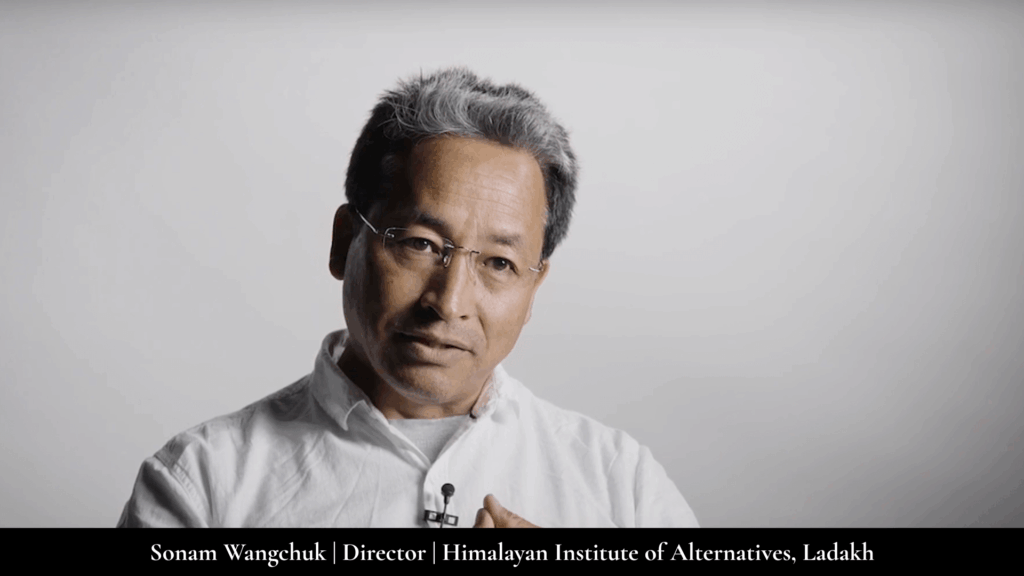
Wangchuk gave up his career as a mechanical engineer and decided to teach kids for a living. He set up the Student’s Educational and Cultural Movement of Ladakh (SECMOL) in 1988, which is located 12 km from Leh.Wangchuk said that SEMCOL was founded in 1988 by students who were, “victims of an alien education system foisted on Ladakh.” He has set up the campus in Ladakh that runs on solar energy and uses no fossil fuels for lighting, cooking, or heating.Faculties that are developed in students at the SECMOL campus-hands symbolize practical knowledge instead of theoretical, mind (one’s logical reasoning), and heart (having empathy for others).
SEMCOL offers eco-friendly living campus which is largely solar powered. They use solar electricity for all their heating, electricity, and pumping. The campus has two solar cookers and solar water heaters for bathing. Most noteworthy are the campus buildings, which stay warm through the coldest months of winter with only passive solar heating. They have been building experimental rocket stoves for the kitchen, that are extremely effective and efficient at using firewood and waste paper. The campus has low-tech soar water heater, solar cookers and solar pumps. They try to produce as much of our own food at SECMOL as they can. They emphasize for Organic Gardens and Trees. They use manure from their own cows and composting toilets, and have never used chemical fertilizers or pesticides. The campus has its own dairy and what not!
The campus visit is full of learning about innovations and its implementation, the mind behind all these is of Mr. Wangchuk. Ice Stupa is his innovation
In January 2014, Wangchuk started a project called the Ice Stupa. His aim was to find a solution to the water crisis being faced by the farmers of Ladakh in the critical planting months of April and May before the natural glacial melt waters start flowing. By the end of February in 2014, they had successfully built a two-storey prototype of an ice stupa which could store roughly 150,000 litres of winter stream water which nobody wanted at the time
In 2015, when Ladakh faced a crisis due to a landslide which blocked the Phugtal river in Zanskar and caused formation of 15 km long lake which became a huge threat for the downstream population, Wangchuk proposed to use a siphon technique to drain the lake and water jet erosion to safely cut the edges instead of blasting the lake as was being planned. However, his advice was ignored and blasting work was carried on. On 7 May 2015, the lake finally burst into flash flood which destroyed 12 bridges and many fields. In 2016, Wangchuk started applying the Ice Stupa technique for disaster mitigation at high altitude glacier lakes. He was invited by Government of Sikkim to apply siphon technique for another dangerous lake in their state. In September 2016, he led a three-week expedition to the Lhonak Glacial Lake in North-West Sikkim, which had been declared dangerous for the last few years.His team camped for two weeks at the lake, amidst rain and snow, installing the first phase of a siphoning system to drain the lake to a safer level until other measures were taken up. In late 2016, the idea started gaining traction from the authorities in the Swiss Alps. Wangchuk was invited by the president of Pontresina, a municipality in the Engadin valley, Switzerland to build Ice Stupas to add to their winter tourism attractions. In October 2016, Wangchuk and his team went to the Swiss Alps and started building the first Ice Stupa of Europe, together with the Swiss partners. In February 2018, a group of young local sculptors and artists from Ladakh built an actual 10-feet high ice stupa. The wondrous sculpture is made entirely of ice and it took them 25 days of hard work and dedication to complete the project. What makes it more special and challenging for the team was the extreme conditions under which they’ve worked. As the stupa was housed inside another giant ice tower (ice stupa artificial glacier), they have to work in very low temperature of at least -12 degrees Celsius.
Ladakhi engineer, innovator, environmentalist and educationist Sonam Wangchuk is among two Indians who have been awarded the Ramon Magsaysay Award, regarded as the Asian version of the Nobel Prize.“In electing Sonam Wangchuk to receive the 2018 Ramon Magsaysay Award, the board of trustees recognizes “his uniquely systematic, collaborative and community-driven reform of learning systems in remote northern India, thus improving the life opportunities of Ladakhi youth, and his constructive engagement of all sectors in local society to harness science and culture creatively for economic progress, thus setting an example for minority peoples in the world,” a statement on the Award’s website noted.He also was awarded as Honorary D.Litt. by Symbiosis International, 2018, Eminent Technologist of the Himalayan Region by IIT Mandi, 2018, Indians for Collective Action (ICA) Honor Award 2017, San Francisco, CA and the list is long.
Dr. Wangchuk often says that teach students what they love, he adds that Don’t blame the child for forgetting lessons, make the lessons unforgettable and we take this as advice for all our readers.
Information You Can Trust: Enterprise Times Magazine delivers timely, well-researched business stories and leadership insights that matter. From enterprise innovation and technology to finance, sustainability, and global markets, we provide reliable coverage that keeps decision-makers informed, inspired, and ahead in a rapidly evolving business world.
Copyright 2026, Enterprise Times Magazine All Rights Reserved.